🎓 How to Play Mighty

Korea's finest card game of wits

Origins

Mighty traces its roots back to Bridge. Bridge crossed over to Japan and was reborn as a variant called Napoleon, which then made its way to Korea, where original rules and a distinctly Korean flavor turned it into Mighty.

In the 1970s and 80s it swept through Korean university campuses as the go-to game of club rooms and student retreats, and in the 1990s it spread quickly among teenagers through gifted-education programs. It went on to reach the army, workplaces and family gatherings, becoming a beloved national card game across generations.

The name "Mighty" comes from the nickname of the game's strongest card, the Ace of Spades — a single card that can flip an entire hand, and the very symbol of the game.

Today

In the digital era, Mighty is expanding onto online and mobile platforms. Its many unique rules — the trump suit (giruda), the hidden Friend, the Joker call — and its depth keep it from mass-market fame, and today it lives on mainly through online and offline enthusiast groups.

Why it hooks you

Mind games under incomplete information — With only the 10 cards in your hand, you deduce where the other 43 are, reading the clues that pour out of every trick. The tension is electric.

The thrill of hidden roles — A Friend playing innocent, defenders hunting for the Friend, a declarer shielding them. This triangle writes a new drama every single hand.

The joy of the comeback — Cutting off the flow with a single Joker, flipping the game with the Mighty, or devouring an ace with a perfectly timed trump ruff — these are the moments that make you say "one more hand."

Why Mighty Korea

  • 💰 Completely free — every feature, no paywalls
  • 🤖 Play vs AI — start instantly against 4 AI players, any time
  • 👫 Play with people — join a live table and play with real players
  • 🌱 Beginner mode — recommended cards and strategy notes every turn
  • 🏆 Rankings & records — weekly and lifetime stats, win rates by role
  • 📱 PC · Mobile — plays right in your browser, no app install

"Thirty minutes to learn, a month to get good, a lifetime to master."
Step into a world of luck and skill, cooperation and betrayal, played out over 53 cards.

This chapter is not about the rules — it is about how a game actually runs on this site. If you are new here, reading just chapters 1 and 4 is enough to start playing.

1. Getting started

Play instantly, no sign-up

Press 🤖 Play vs AI on the home screen and a game starts immediately — no registration. A guest account is created automatically and you play against 4 AI players right away.

Note that guests do not keep records, win rates, rankings or trophies. When the hand ends, nothing is saved.

What changes when you sign up

FeatureGuestMember
Play vs AI
Records · win rates · per-role stats
Rankings · trophies · tiers
My game replays
Solino Chance · event rewards

Tap the "Sign up and keep your records" card at the top of the home screen to open the sign-up window. You can register with a social account, or add one later via account linking.

2. The home screen at a glance

From top to bottom it is laid out like this.

AreaWhat it shows
ProfileYour tier, trophies, record and Solino Chance count. Change avatar and nickname
🎓 How to Play MightyRules and strategy lessons, plus master-game replays
🤖 Play vs AIStart instantly against 4 AI players
🎉 Ongoing eventsAttendance, milestones and other progress
🎮 Games in progressLive tables. Click to wait means you can join
📋 Recent resultsOnly big hands (±40 points or more)
Ranking board / 🏅 Hall of FameWeekly and daily points, monthly record leaders
📜 My game replaysRewatch hands you played
📋 BoardNotices and suggestions

3. Starting a game

① Play vs AI — solo, instantly

🤖 Play vs AI → pick your options in the confirmation popup and press [Start].

  • Allow others to replace an AI — when checked, another user may take over an AI seat mid-game. Uncheck it if you want a quiet solo game.
  • Use Solino Chance — appears only when you own a voucher. Using one starts the hand with a dream deal: the Mighty + the Joker + 5 trumps.

② Join a game in progress

In the 🎮 Games in progress list, tap a table marked Click to wait to queue for the next hand. You join as soon as the current hand ends and a seat opens.

4. Reading the game screen

How to read the table

Below is a real game screen. Almost everything about the current hand is in this one shot.
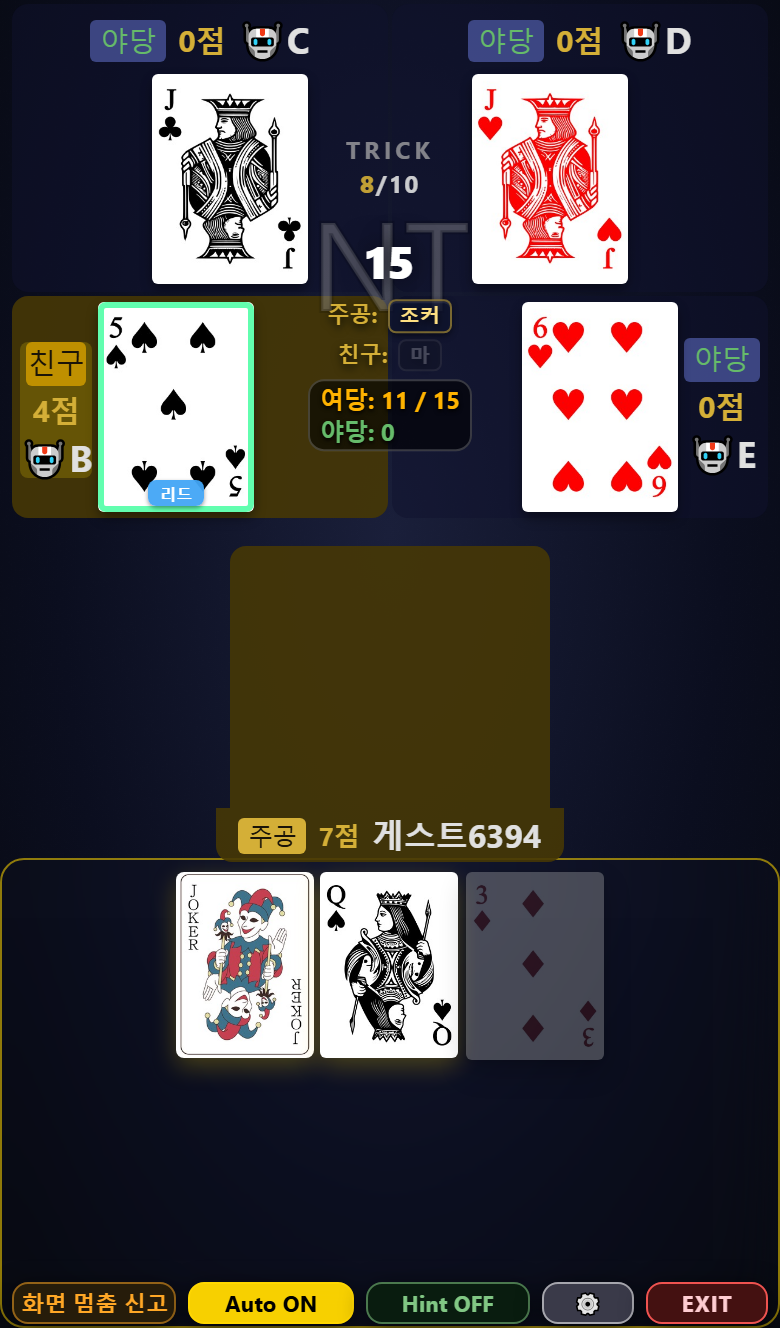
Mighty game screen — declarer and friend in gold, defenders in indigo
No-trump (NT) contract of 15, trick 8. I am the declarer (bottom), B is the Friend, and C·D·E are the defenders. In the center, Declarer: Joker is bright while Friend: Mighty is dimmed — meaning the Mighty has already been played but the Joker is still live.

Teams are color-coded

  • Declarer's team (declarer & Friend)gold background. The declarer is slightly darker, the Friend lighter. The Declarer / Friend badges next to their names are gold too
  • Defendersindigo background with a blue Defender badge
  • Until the Friend is revealed, their seat shows Unknown. The moment the Friend card hits a trick, that seat turns gold — so just watching the background colors tells you who the Friend is

Center — the contract and the team's key cards

The big suit symbol and number in the middle of the screen are the trump suit (giruda) and the contract. The two lines beneath them are the key.

  • Declarer: the Mighty / Joker the declarer is known to hold
  • Friend: the Friend card, and the Mighty / Joker the Friend holds

Cards are shown by shorthand.

LabelMeaning
Mightythe Mighty (♠A)
Red Mightythe Mighty when spades are trump (◆A)
Trump Kthe King of trumps
Jokerthe Joker
No Friendthe declarer plays alone, without a Friend
This is the most useful readout on the screen. Once these cards are actually played, they turn gray from the next trick on. In other words, a card still shown bright is still in the team's hands. That is exactly the difference between the bright and dimmed cards in the screenshot above. Check every trick whether the Mighty and Joker are still live, and time your own cards accordingly.

Below that, Declarers ○ / contract and Defenders ○ are the points collected so far. When the declarers' number reaches the contract, the declarer's team wins. Points not yet decided show as Open.

Your hand and trick progress

  • Your hand is at the bottom. The system enforces the rules automatically and dims cards you cannot legally play, so just tap any bright card. In the screenshot, the ◆3 on the far right is dimmed for exactly that reason
  • Card borders — green marks the current boss card (the strongest card still winning the trick). In the screenshot, the led ♠5 has the green border
  • The Trick 5/10 indicator at the top tells you which of the 10 tricks you are on
  • The number next to your name is the points you have taken so far

Bidding
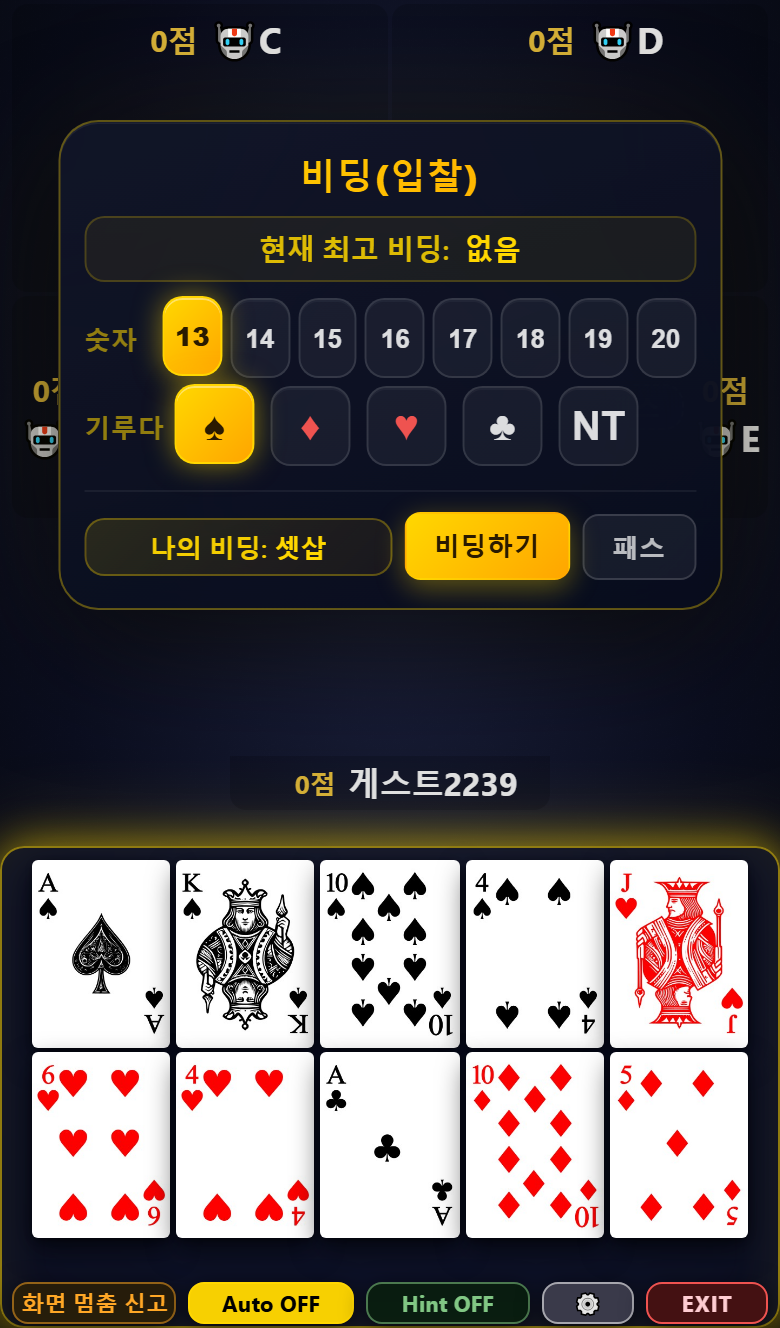
Bidding screen — choose a number and a trump suit, then bid
The bidding screen. From the top: current highest bid, number (13–20), then trump suit (♠ ◆ ♥ ♣ NT).
  • Number — the points you promise to take, from 13 to 20. The higher you bid, the likelier you become declarer, but the heavier the burden
  • Trump (giruda) — the suit you want as trump. NT means no-trump
  • My bid — previews your chosen combination, e.g. 13 Spades. Press Bid to confirm
  • Not confident? Pass. Even after passing, you get another turn if someone bids higher before you
  • You can only bid higher than the current highest bid. If no one has bid yet, it shows None

Time limits apply only when playing with humans. In a game with human players, you auto-pass after 40 seconds, with a warning at 10 seconds left. Solo games against AI have effectively no limit, so take your time.

If everyone passes, the cards are redealt — and the score multiplier for the next hand goes up. Each consecutive all-pass raises the multiplier further, so a hand after repeated redeals plays for much bigger points than usual.

When you become declarer ① The exchange
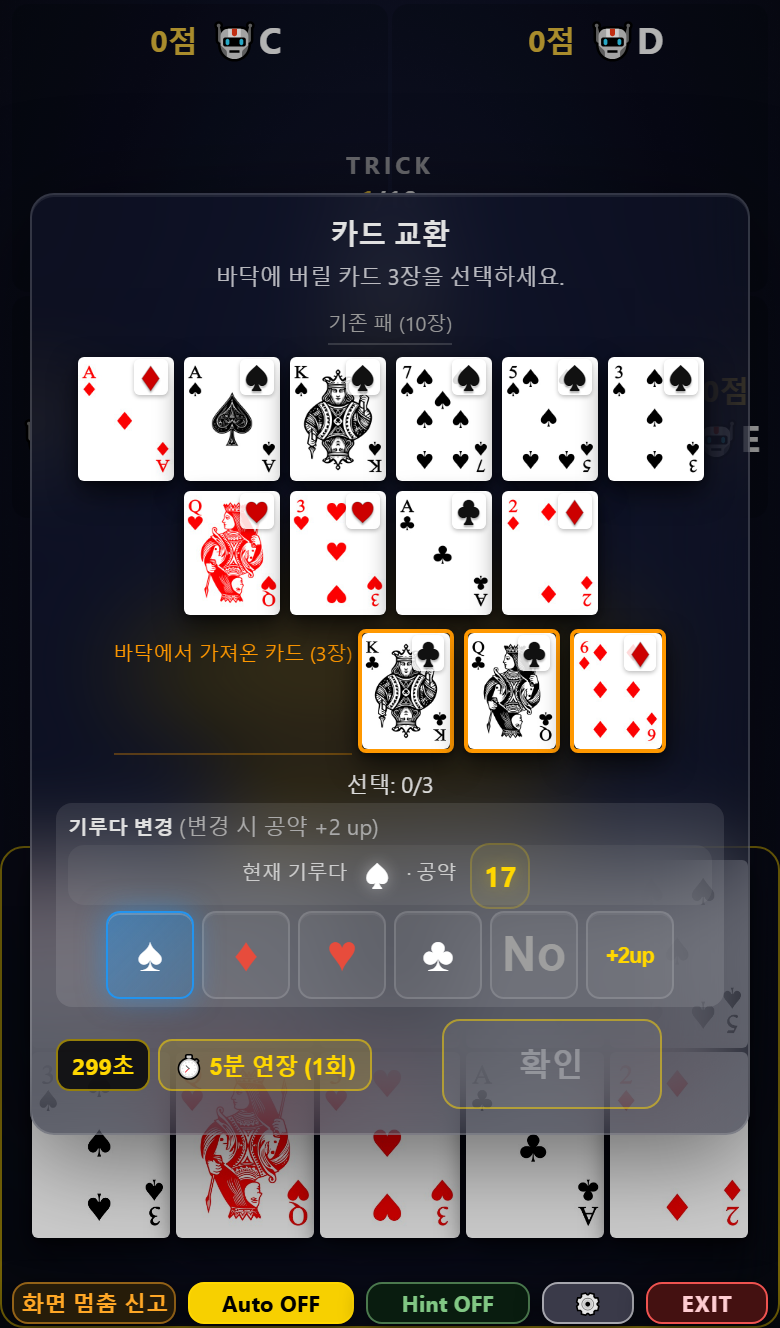
Exchange screen — pick 3 cards to discard, optionally change trump
You have received the 3-card kitty and now hold 13 cards. Orange borders mark the cards that came from the kitty.
  • The 3-card kitty is added to your 10 cards, giving you 13. The 3 new cards are marked with an orange border
  • Tap 3 cards to discard. Your progress shows as Selected: n/3, and Confirm activates once all 3 are chosen
  • Point cards among your 3 discards still count toward the declarer's team score. If you cannot protect a point card, discarding it is safer than holding it and losing it to the defenders
Changing trump — after seeing the kitty you may change the trump suit, but your contract goes up by 2. Press +2up to keep the trump and raise only the contract by 2; press it again to cancel. Changing trump and +2up together means +4. The current trump · contract display shows your terms at all times.
⚠️ Discarding a key card — if your discards include the Mighty, the Joker or a trump, a confirmation dialog appears when you press Confirm. Choose Proceed or Cancel (pick again). It is a safeguard against accidentally throwing away a game-deciding card — if it was not intentional, cancel and re-pick. If you changed trump, the check uses the new trump suit.

You get 5 minutes for the exchange, plus one 5-minute extension. The remaining time is shown at the bottom of the screen in seconds.

When you become declarer ② Calling the Friend
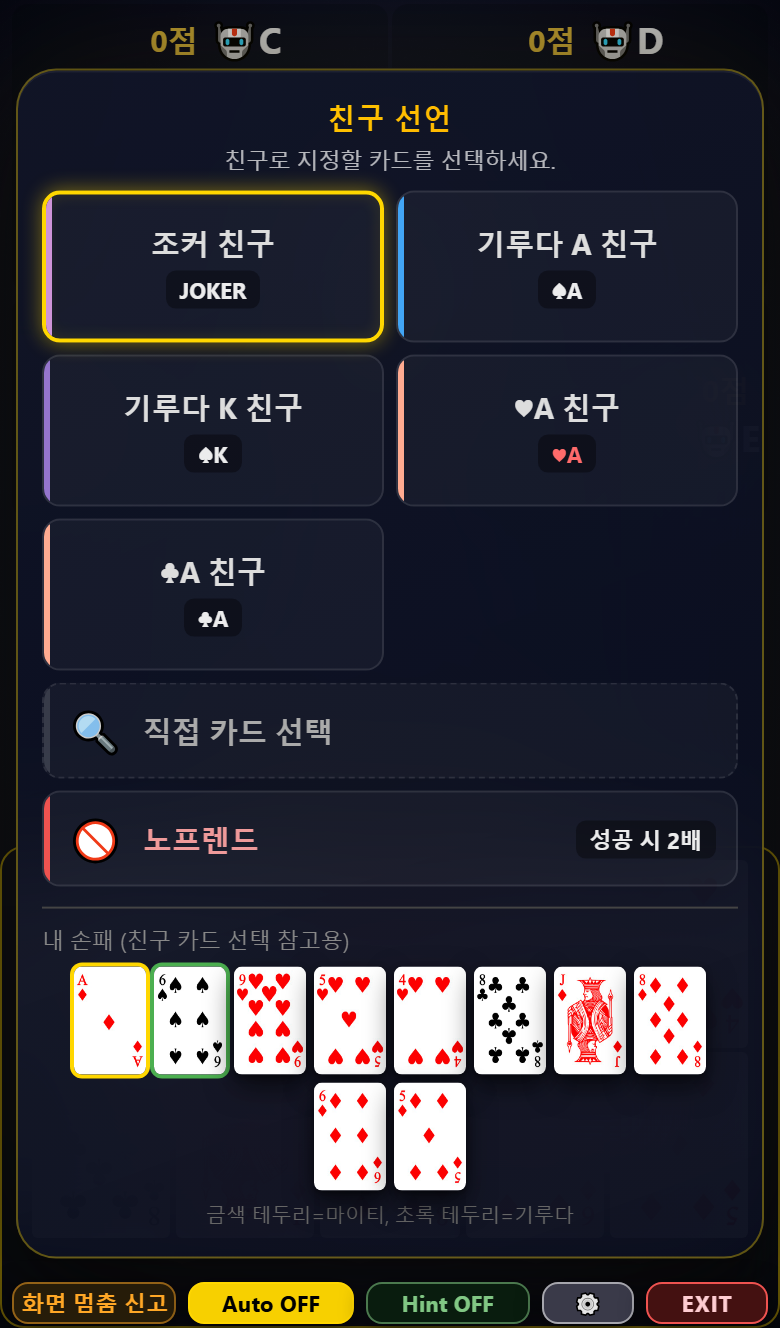
Friend selection screen — Joker friend, trump-A friend, or No Friend
Common choices are ready as one-tap buttons, and your hand is shown at the bottom for reference.

You choose your partner by card, not by person. Whoever holds that card becomes your Friend, and nobody knows who the Friend is until that card is played to a trick.

  • Common calls like Joker friend · trump-A friend · trump-K friend are one-tap buttons
  • For anything else, use 🔍 Pick a card to choose a suit and rank
  • If you call a card you already hold, you are effectively playing alone. Check your hand before deciding
🚫 No Friend — take on the contract alone, with no partner. Succeed and your score doubles — but so does the cost of failure.

Your hand is shown at the bottom for reference. A gold border marks the Mighty, green marks trumps — look at what you hold, and call the card you are missing as your Friend.

The Joker

When you lead the Joker, you declare a suit ("Hearts!", "Spades!" and so on). If a Joker call forces the Joker out, a special animation shows it.

Utility buttons (bottom of the screen)

Utility buttons at the bottom — report freeze, Auto, Hint, settings, EXIT
Five buttons that stay docked at the very bottom of the game screen.
ButtonWhat it does
AutoLets the AI play your turns. Shows Auto ON while active
HintShows a recommended card
⚙️ SettingsPost-trick delay, emoticon position, language
Report freezeIf the screen seems stuck, press it and the server attempts recovery
EXITLeave the room

Auto is not just for stepping away. When the outcome is already decided and only mechanical mop-up remains, turn it on and the AI will finish the remaining tricks for you. Handy for skipping through the last few tricks once the contract is clearly made or broken.

You can communicate with other players using emoticons.

⚠️ If you step away
· In games with human players, 30 seconds of no response means the AI takes over and you receive a penalty. Turn on Auto before stepping away.
· Leaving does not end the game. The AI plays it out, and the result counts toward your real score.

5. After the game

Scoring

Each hand's gains and losses go straight into your points. On top of that:

  • Win-streak bonus — consecutive wins multiply your score (2 in a row ×1.5, 3 in a row ×2 …)
  • Run / back-run streak bonus — stacks the same way
  • All-pass multiplier — hands that followed a redeal are multiplied accordingly

The result screen shows it as base ○ + bonus ○ = total.

Tiers and trophies

Your tier is decided by trophies, not points.

TierTrophies
🌱 Sprout0 – 9
🥉 Bronze10 – 49
🥈 Silver50 – 99
🥇 Gold100 – 149
💠 Platinum150 – 199
♤ Mighty200+ · advances every 200

The Mighty tier steps up every 200 trophies — Single 200 · Double 400 · Triple 600 · Quadruple 800 · Grand 1000+. See where you stand under Lifetime details → ⓘ Tier guide on the lobby ranking board.

Trophies are awarded through ranking settlements.

  • Daily — awarded to ranks 1–10 at midnight (KST) each day. Requires 3+ games that day
  • Weekly — awarded to ranks 1–10 at midnight (KST) on Mondays. Requires 20+ games that week

Points reset every Monday, but trophies accumulate for life and are never deducted.

Replays

📜 My game replays lets you rewatch any hand you played, trick by trick — including why the AI played each card.

6. Solino Chance and events

Solino Chance

A voucher that starts one hand with a dream deal: the Mighty + the Joker + 5 trumps.

  • Earn 1 voucher per 20 AI games (progress shown in the AI start popup)
  • After using one, there is a 30-minute cooldown
  • If the game falls apart mid-hand, the voucher is refunded automatically

Standing events

EventConditionReward
Attendance30 games a day, 7 daysSolino Chance +3 and up (grows each consecutive week, max 7)
5,000 lifetime gamesyour personal totalSolino Chance +10
Reaching Mighty ② or higher400+ trophiesSolino Chance +20

Track your progress under 🎉 Ongoing events on the home screen.

7. Troubleshooting

SituationWhat to do
The screen seems frozenPress Report freeze at the bottom. If that fails, refresh with F5 — the game continues where it was
Buttons will not respondRefresh with F5. You return to your hand in progress automatically
I need to step away brieflyTurn on Auto. In a game with humans, leaving it means AI takeover + a penalty after 30 seconds
The AI played a strange card🐛 Report this game — the developer actually reviews the replay and fixes it
I found a masterpiece game🎬 Recommend as showcase — it becomes a master-replay candidate. Requires the Mighty tier (200 trophies) or higher
Do I need to install an app?No. It runs right in your PC or mobile browser
Does it cost money?Everything is free. There are no paid features

A complete guide to Mighty for beginners and intermediate players. Work through the courses below, from the basics to advanced technique.

🖥️

We recommend using this guide on a desktop or tablet. The replay viewer is hard to use on a phone.

📘

Basic Rules

From the deck, the goal and the flow of a hand to lead/follow, card ranking, bidding and calling the Friend — the complete rules of Mighty, start to finish.

🧭

Basic Strategy

A strategy map organized by role (declarer · Friend · defender) and situation (lead / follow), with real cards you can click through.

🎯

Annotated Games

Hand-picked beginner games for each role, replayed trick by trick with commentary — take your time and watch the rules come to life.

🏆

Master Replays

Games recommended by Mighty-tier players. A precious chance to pick up strategies and card-handling techniques you did not know.

The basic rules of Mighty from start to finish — the deck, the goal and the flow of a hand, then lead/follow, card ranking, bidding and calling the Friend, all in one place.

1. Overview

Mighty is a Korean trick-taking card game for 5 players using a single deck. It shares roots with Bridge, but creates a unique tension of its own: the partnership is decided fresh every hand — and it is hidden.

The deck

  • A standard 52-card deck + 1 Joker = 53 cards
  • Each of the 5 players is dealt 10 cards (50), and the remaining 3 cards form the kitty.

Structure of the game

  • Every hand, one declarer (who leads the attack) + one Friend form a team, and the remaining 3 players are the defenders.
  • The Friend's identity stays hidden well into the hand, so figuring out "who is on my side?" is the heart of the fun.

Alongside the luck of the deal, bidding judgment, Friend selection and card-play technique all matter — a well-balanced game of luck and skill.

2. The goal

Each hand is decided by who takes more of the point cards.

Point cards (20 in total)

  • The 10, J, Q, K and A of each suit (♠♥◆♣) → 5 per suit × 4 suits = 20 cards
  • The other cards (2–9) score nothing, but they are your tools for winning tricks.

What each team wants

  • Declarer's team (declarer + Friend): collect at least the number of point cards the declarer promised in the bidding (the contract). E.g. with a contract of 13, they must take 13 or more of the 20.
  • Defenders (the other 3): steal enough point cards to break the contract. E.g. with a contract of 13, the defenders win by collecting 8 or more point cards.

At the end of the hand, the score is settled based on whether the contract was made, by how much it was exceeded or missed, and whether the hand was no-trump (which pays a bonus).

3. Flow of a hand

A hand proceeds in this order.

  1. The deal — 10 cards each, 3 to the kitty.
  2. Bidding — players bid a trump suit (giruda) and a contract to decide the declarer. (→ ch. 6)
  3. Exchange & final contract — the declarer picks up the 3-card kitty (13 cards), then discards 3 back down to 10. At this point they may change the trump suit or raise the contract — but changing trump costs +2 on the contract.
  4. Calling the Friend — the declarer chooses who will be on their side. (→ ch. 7)
  5. Card play (10 tricks) — 10 tricks are fought under the lead-and-follow rules. (→ ch. 4)
  6. Scoring — count the declarer team's point cards, judge the contract, and settle the score.
A hand normally lasts 10 tricks (each player plays out 10 cards).
📱 The flow of a hand, in actual game screens

4. Lead and follow

Card play proceeds in tricks. In one trick, all 5 players play one card each, and whoever played the strongest card takes the trick.

The lead

  • Playing the first card of a trick is called the lead. The suit of that first card becomes the trick's reference suit.
  • The declarer leads the first trick. After that, whoever won the previous trick leads the next one.

Following

  • If you hold cards of the led suit, you must play one. This is the obligation to follow suit — the single most important rule in Mighty.
  • If you have none of the led suit, you may play any card, including trumps and special cards.
  • When a player out of the led suit plays a trump to steal the trick, that is a ruff (called a "cut" in Korean). When another player overturns it again with a higher trump in the same trick, that is an over-ruff.

Who wins the trick

  1. If any trump was played, the highest trump wins.
  2. If no trump was played, the highest card of the led suit wins.
  3. Special cards — the Mighty and the Joker — override both rules. (→ ch. 5)
First-trick restriction: you may not lead a trump on the first trick. The usual opening is a non-trump boss card.

5. Card ranking and special cards

Basic ranking within a suit (high → low)

A > K > Q > J > 10 > 9 > 8 > 7 > 6 > 5 > 4 > 3 > 2

Trump (giruda, TRP)

  • The suit chosen in the bidding is trump. Any trump beats any card of any other suit.
  • A hand with no trump suit is called no-trump (NT).

Special cards (strongest first)

RankNameAbbr.CardEffect
1The MightyMTY♠AThe strongest card — beats everything.
2The JokerJKRJokerBeats everything except the Mighty. When led, may name a suit.
3Joker CallJKC♣3When led, cancels the Joker's power.

Exceptions

  • If spades (♠) are trump, the ♠A becomes a trump, so the Mighty becomes the ◆A (Ace of Diamonds).
  • If clubs (♣) are trump, the ♣3 becomes a trump, so the Joker Call becomes the ♠3 (as designated by the rules).

The Joker vs. the Joker Call

  • Whoever leads the Joker may name a suit — for example, calling "Hearts!" forces every other player holding hearts to play one.
  • But if someone leads the Joker Call (♣3) first, the Joker's holder can only play it as an ordinary card, powerless for that trick.
  • The Joker has no power on the first and last tricks — it loses to everything there, so play it somewhere in between.
🃏 Guess the Trick Winner tap the winning card
1/20Correct 0
This is the most important part of the whole guide. If you cannot read who wins a trick at a glance, none of the strategy that follows will be usable. Do all 20 questions — do not skip. It is fine to get them wrong at first; the pecking order of trump, Mighty and Joker sinks in through the ones you miss.
Revealing the cards…
Cards are played clockwise from the leader.

6. Bidding

Bidding is an auction where you declare: "I will be declarer, with this suit as trump, and I take responsibility for this many points."

What you bid

  • A trump suit (TRP) + a contract (the number of point cards you will take)
  • E.g. "14 Spades", "13 No-trump (NT)"

Minimum contract

  • With a trump suit: minimum 13
  • No-trump (NT): much harder to play, so bid it carefully. (A 13 NT is roughly on par with an ordinary 14.)

How it proceeds

  • In turn order, each player either bids higher than the previous bid or passes.
  • Once you pass, you are out of the bidding for that hand.
  • The last player standing — the highest bidder — becomes the declarer.

Raising the contract

  • If the kitty improves the declarer's hand, they may raise the contract even after the bidding ends.
  • The higher the contract, the bigger the reward for success — and the risk of failure.
If everyone passes and no declarer emerges, or if a hand has no point cards (including a Joker with at most one point card), the cards are redealt.

7. Calling the Friend

Once the declarer is decided, they choose one Friend (FRD) to help them. The Friend's identity stays secret until the condition is met, so for everyone else, "am I the Friend — or the enemy?" becomes the hand's central question.

Common ways to call a Friend

  • Mighty Friend — whoever holds the ♠A (the Mighty) is the Friend.
  • Joker Friend — whoever holds the Joker is the Friend.
  • Card-call Friend — the declarer names a specific card (e.g. "Ace of Hearts") and its holder is the Friend. The most common choice.
  • No Friend — the declarer takes on all four opponents alone. The biggest payout if it succeeds.

When the Friend is revealed

  • The Friend is revealed the moment the named card is played to a trick.
  • Until then, even the Friend themselves — and certainly the defenders — must play while deducing who is who.

Strategy point

  • The key is to recruit the holder of the card that patches your weakness — a missing suit or a soft spot in your hand.

Appendix: key terms

TermAbbr.Meaning
DeclarerDECThe bidding winner who leads the attack (Korean: jugong)
FriendFRDThe hidden partner on the declarer's team
Declaring sideDECsDeclarer + Friend
DefendersOPPsThe other 3 players, opposing the declarer's team
Trump (giruda)TRPThe hand's trump suit
No-trumpNTA hand with no trump suit
ContractThe number of point cards the declarer's team promised to take
Point cards (honors)The 10·J·Q·K·A of each suit (20 in total)
The MightyMTYThe strongest card, beating everything (normally ♠A)
The JokerJKRThe second strongest card
Joker CallJKCThe card that cancels the Joker (normally ♣3)
TrickOne round in which all 5 players play one card
Lead / FollowPlaying a trick's first card / playing to its suit
KittyThe 3 cards set aside at the deal (taken by the declarer)
※ This guide is based on the detailed rules used at mightykorea.com.

A collection of teaching games, organized by role (declarer · Friend · defender) and by trump / no-trump. Tap the situation you want to study to open the replay; use Back to menu inside a replay to return here.

Games recommended by Mighty-tier players. Watch them to pick up strategies and card-handling techniques you have not seen before.

Terms you need for the strategy section

These words come up constantly in the strategy notes — skim them before you start. Only the concepts and states needed to read the strategy are here. (For the basic cards — Mighty, Joker, trump, Joker Call — see Basic Rules.)

Mighty basic strategy

Knowing the rules is not the same as playing well. Without basic strategy, every turn feels like a blind guess. What you really need to win is the right play for your role and situation.

1Who am I?
Declarer · Friend · Defender (declaring side = declarer + Friend)
2Leading or following?
Am I starting this trick, or playing to it?
3Winning or losing?
If following — is my team currently winning this trick?

The strategy map below is built on exactly these three questions. First it splits by ② lead vs. follow; the lead group splits by ① your role (declarer · Friend · defender), and the follow group by ③ whether you are winning right now. Answer the three questions and exactly one cell applies to you. Techniques that work regardless of role or situation are collected at the bottom.

The strategy map, by role and situation

Only read the cell your three answers point to. For each strategy, note the how and the why.

Got all that? Time to see it in real hands.

Strategy sticks far faster when you watch it in real tricks than when you read it. Annotated Games has real games sorted by role (declarer · Friend · defender) and by trump / no-trump, with trick-by-trick commentary showing exactly where each strategy you just learned was used.